


2. THEORETICAL FOUNDATIONS
2.3. Columns plats
2.3.3. Analytical calculation
The analytical calculation allows us to determine the amounts of theoretical plates needed for a particular separation.
The calculations start from the bottom of the column to reach the top. Uses the principle of perfect dish, which the liquid and gas streams are in equilibrium with respect to temperature and composition.

Figure 2.9: Representation of the column gas absorption plates.
Here present the total and partial mass balances in the solute to the plate n:
TOTAL BALANCE:
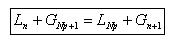
SOLUTE BALANCE:

From an enthalpy balance can be found Ln i xn :
SOLUTE BALANCE:

Where:
Ln: total moles/time of liquid stream in the plates n.
GNp+1: total moles/time on the plate Np+1.
LNp: liquid stream total moles / time plate n.
Gn+1: total gas flow in moles / time in the plate n +1.
xn: molar composition of the solute (liquid) in the late n.
yNp+1: molar composition in the gas component (solute) in the plate Np +1.
xNp: molar composition of the solute (liquid) in the plate Np +1.
yn+1: molar composition in the gas component (solute) in the plate n +1.
HL,n: enthalpy of liquid on plate n (energy/mol).
HG,Np+1: enthalpy in the gas stream on the plate Np +1 (energy/mol).
HL,Np: enthalpy of the liquid in the plate Np (energy/mol).
HG,n+1: enthalpy in the gas flow on the plate n +1 (energy/mol.)
With the liquid stream on the plate n (Ln) can determine the working temperature, so the gas flow on the plate n (Gn) is at the same temperature, the liquid stream in the same dish. Therefore the material balance and enthalpy of the plate applied from n-1 to the top of the column.
Initially the general data are the temperatures and currents L0 and GNp+1, so you need to calculate the temperature t1 of the current gas G1, this will be the same temperature in the upper plate. With the help of the total enthalpy balance, you can calculate the temperature of liquid leaving the bottom of the column. The estimation of the calculations is verified when you reach the top plate of the column.
To determine the number of theoretical plates can be made from two different equations based on initial data that are known. The first option is presented below:
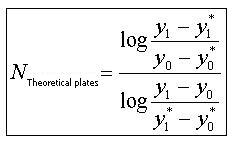
Where:
y1 * and y0 *: concentrations in equilibrium with a concentration of the liquid out, xn.
y1 and y0’: gas concentrations.
The second option is to find the theoretical number of plates with the equation and Kremser-Souders-Brown. Is the following:
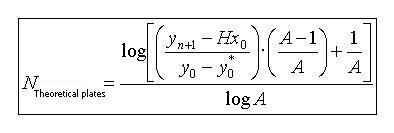
Where:
A: absorption factor.
Hx: Henry constant.
This equation can be used only in the case of mixtures of gases and liquids that meet Henry's law.